Mission
Human movement control relies on proactive mechanisms expressed in motor planning, as well as retroactive mechanisms based on sensory feedback which govern online movement corrections and trial-by-trial motor adaptation. We recently demonstrated that the adaptive processes involved in reaching movements within altered force fields extend to online control mechanisms, thereby enabling efficient corrections during movement execution in response to visual or mechanical perturbations. However, the kinematic and muscular organization of movements were shown to be influenced by the uncertainty in the conditions of movement execution, for instance when an unexpected perturbation occurs. Thus, the mere knowledge that a movement may be perturbed seems to pre-constrain the sensorimotor system during adaptation to a novel environment. We hypothesize that this situation is managed through the integration of a possible perturbation into the organization of the planned motor commands.
A critical question, however, arises when a perturbation that is “unpredictable” (i.e., its occurrence is expected but its timing remains unknown) becomes “unforeseeable” (i.e., neither its occurrence nor its nature can be anticipated). Specifically, how do humans adapt to a modified force field while simultaneously facing an unforeseeable perturbation affecting task execution (e.g., an unforeseen displacement of the target)? Although recent evidence suggests that co-activation mechanisms can enhance feedback control under unpredictable perturbations, it remains unclear whether such mechanisms generalize across different contexts of uncertainty. More importantly, in the broader framework of motor adaptation to novel force fields, the extent to which perturbation uncertainty impacts the time course and quality of adaptation remains an open question.
The present doctoral project aims to investigate the role of perturbation-related uncertainty in the adaptation of reaching movements within modified force fields. Specifically, we will manipulate the degree of uncertainty regarding perturbations applied during the adaptation phase to a novel force field (e.g., under altered gravitational conditions such as microgravity or hypergravity). Here, the level of uncertainty is considered inversely proportional to the amount of available information about the perturbation. This information may be provided explicitly, through prior instructions, or implicitly, through the frequency, magnitude, or sensory consequences of the applied perturbations. Particular attention will be devoted to the evolution of kinematic and electromyographic features of unperturbed movements, in order to characterize the adaptive dynamics of reaching in force fields across different uncertainty contexts.
During the first year, we will focus on the effects of explicit uncertainty related to perturbation context on sensorimotor adaptation. For this purpose, we will use a visuomotor perturbation paradigm applied during a sustained exposure to a modified force field (simulated or real), using the experimental facilities available in our lab (ranging from immersive virtual reality to full-body centrifugation via our rotating platform). The instructions provided to participants will be systematically manipulated to modulate their knowledge of the upcoming adaptive context.
In the second year, we will address the effects of implicit uncertainty, inferred by participants from the perturbations themselves as no instructions will be provided. Depending on perturbation frequency and nature, we aim to demonstrate that adaptive processes within a modified force field differ significantly and determine motor performance during reaching tasks.
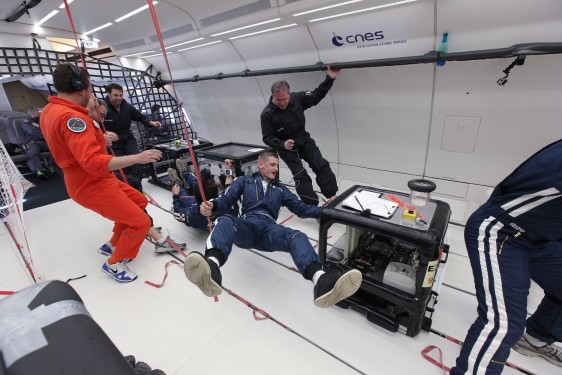
The final year will investigate differences in the processing of perturbation-related uncertainty across different force fields, particularly under reduced, suppressed, or increased gravitational load. To this end, participants will be exposed to microgravity and hypergravity phases during parabolic flights, or to varying load factors applied on our ground-based experimental platforms. We will analyze in detail the adaptation processes across these different uncertainty conditions.
The significance of this project lies both at a fundamental level, by improving our understanding of motor representations and their underlying neuropsychological processes, and at an applied level, by refining the definition of favorable conditions for human motor adaptation in novel gravitational environments.
The project will be supported by 1/ The extensive experimental facilities of the lab which allow investigation of adaptive processes in environments with varying force fields (e.g., rotating platform). 2/ The recognized expertise of the co-investigators, demonstrated by numerous international publications directly related to this topic, as well as prior successful supervision of a CNES-cofunded doctoral project on a related subject.
=================
For more Information about the topics and the co-financial partner (found by the lab!); contact Directeur de thèse - lionel.bringoux@univ-amu.fr
Then, prepare a resume, a recent transcript and a reference letter from your M2 supervisor/ engineering school director and you will be ready to apply online before March 13th, 2026 Midnight Paris time!