
Mission
Antarctic sea ice is critical for climate through its influence on albedo, ocean circulation, heat and carbon uptake, ice-shelf stability. Over the past decade, Antarctic sea ice has declined, reversing previous trends and aligning more closely with climate projections (Himmich et al., 2024). Yet Antarctic sea ice state and key processes remain poorly characterised. Field observations reveal striking contrasts with the Arctic: heavy snowfall, interactions with ice bergs and shelves, and ocean waves. As a result, climate models poorly simulate key Antarctic sea ice phenomena, such as the seasonal cycle, thickness distribution, landfast ice or polynyas. This limits our capacity to predict or explain short-term events and long-term trends.
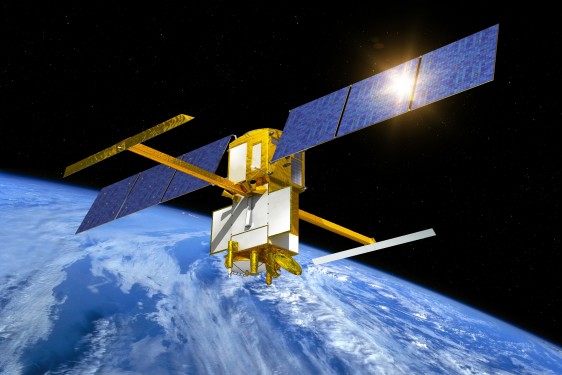
The SWOT mission (launched Oct 2022) can help address this gap. Its KaRIn SAR product resolves surface topography at 500 m daily, distinguishing floes and leads, and retrieving freeboard consistent with CryoSat-2 (Kacimi et al., 2025; Jestin et al., 2025), offering unprecedented means to document how Antarctic sea ice thickness, floes and leads evolve at fine spatio-temporal scales, in interaction with other Earth System elements.
This motivates the main question of this thesis: how can SWOT document the Antarctic sea-ice state and advance understanding of its functioning? We have two main objectives: generate a one-year (2024) classification, concentration, freeboard, thickness product from SWOT; analyse sea-ice dynamics in the Amery Ice Shelf–Prydz Bay sector. Objective 1 evaluates SWOT’s capability to retrieve Antarctic sea-ice state relative to existing products. Objective 2 explores SWOT’s capability to describe fine-scale sea-ice processes.
The choice of the Amery Ice Shelf–Prydz Bay marine region is motivated by its diversity of sea-ice types and processes: coastal landfast ice, polynyas, drifting wave-influenced pack ice. Important climate processes also occur in the region. Prydz Bay is one of the four Antarctic sites of dense water formation, associated with two important polynyas, and features extensive landfast ice anchored by grounded icebergs. The Amery Ice Shelf, the third largest in Antarctica, drains a vast sector of East Antarctica, key to its stability. Finally, numerous in-situ observations are available in the area.
We will generate Antarctic sea-ice products from SWOT, adapting Arctic-based techniques (Jestin et al., 2025), over at least one continuous year (2024). First, we will classify surface types (open water, frazil ice, thin young sea ice, and thick sea ice) and explore the inclusion of icebergs and ice-shelf surfaces. This will then be turned into a sea-ice concentration (SIC) product. How frazil ice affects SIC and lead-fraction distributions will be studied. Concurrently, a sea-ice freeboard product will be derived and converted into thickness using a recent snow-depth product (Carret et al., 2025). All products will be gridded at 5-10 km resolution and evaluated against existing datasets, including MODIS, OSI-SAF, CryoSat-2, to name a few. In a second step, we will focus on small-scale sea-ice processes in the region of Amery Ice Shelf / Cape Darnley, examining features such as polynyas, leads, and interactions between fast ice and drifting pack ice. This will exploit SWOT’s high resolution to investigate fine-scale ice dynamics.
The project leverages the strong expertise of LEGOS in sea-ice remote sensing and of LOCEAN in Antarctic sea-ice physics, enabling a combination of approaches to observing and understanding Antarctic sea-ice processes. This thesis uniquely combines high-resolution SWOT observations with regional process-based analyses, such as fine-scale interactions with icebergs, waves or landfast ice breakup. The work will also provide the first SWOT algorithm for Antarctic sea-ice characteristics, including classification, concentration, freeboard, and thickness. The high spatial resolution and process-level focus of SWOT observations will allow insights previously unavailable from other satellite missions. Key risks include uncertainty in snow depth, affecting freeboard-to-thickness conversion, and potential gaps in SWOT coverage. These will be addressed via multiple datasets, sensitivity analyses, and careful processing.
To conclude, this thesis will produce the first SWOT-based Antarctic sea-ice product and assess its ability to capture fine-scale processes, including wave–ice and iceberg–sea ice interactions, landfast ice, and polynya dynamics. The resulting products will benefit both the sea ice and climate communities, and address issues in simulations of the Antarctic sea ice future.
A. Carret, S. Fleury, A., et al. (Nat. Sc. Dat., 2025).
Himmich, K., Vancoppenolle, M. et al. (JGR, 2024).
Jestin, G., Fleury S., et al. (TC, subm). “New high resolution sea ice leads and floes classification in the CNES SWOT product”.
Kacimi, S., et al. (GRL, 2025).
=================
For more Information about the topics and the co-financial partner (found by the lab!); contact Directeur de thèse - martin.vancoppenolle@locean.ipsl.fr
Then, prepare a resume, a recent transcript and a reference letter from your M2 supervisor/ engineering school director and you will be ready to apply online before March 13th, 2026 Midnight Paris time!
Profile
Laboratoire
Message from PhD team
More details on CNES website : https://cnes.fr/fr/theses-post-doctorats