Mission
Rapid flows of dense granular material such as rock, debris, or snow avalanches are ubiquitous in mountainous regions and represent one of the most efficient geomorphic transport processes on Earth. These flows are difficult to monitor directly, yet they generate characteristic seismic signals that can be recorded remotely. Over the past decade, major advances have been achieved in understanding how mass, velocity, and basal friction control the emitted seismic energy. Field observations have shown that the center-of-mass acceleration and impact dynamics leave distinct signatures across different frequency bands. However, the coupling between long-period signals reflecting bulk motion and high-frequency signals associated with granular impacts remains poorly understood. Bridging these scales is essential for turning seismic observations into quantitative indicators of flow dynamics.
The objective of this PhD project is to establish a physically grounded framework for interpreting the seismic signals of dense granular avalanches by combining data-driven and physics-based approaches. The project will build on the recent development of advanced signal-processing and artificial-intelligence methods that allow complex seismic waveforms to be represented as structured, low-dimensional manifolds. Deep scattering transforms, dimensionality-reduction techniques, and network-based clustering will be used to extract generic features from large catalogs of recorded and simulated events. The resulting families of signals will be interpreted in terms of flow regimes and mechanical parameters such as mass, inertia, and basal friction.
The approach will integrate three complementary datasets:
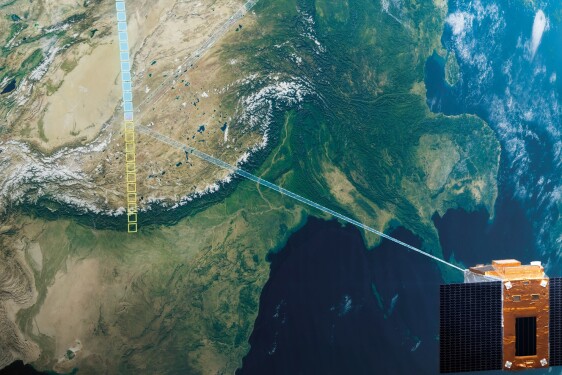
(1) High-resolution orbital imagery, including existing archives and future CO3D acquisitions from CNES/Airbus, which will provide precise 3D topography and change detection;
(2) Seismic catalogues such as ESEC, enabling systematic extraction of avalanche-related signals and metadata; and
(3) Field recordings from instrumented alpine sites where seismic, infrasound, and photogrammetric observations of avalanches will be deployed within the PhD framework.
By jointly exploring these datasets, the student will investigate how statistical patterns in the seismic domain relate to the underlying physical processes and how they scale with topographic context, source geometry, and remotely sensed surface changes. The complementarity between CO3D and ESEC will be particularly exploited to fill current metadata gaps linking source parameters, runout geometry, and seismic energy release.
A second goal of the project is to develop and test physically informed AI models capable of predicting dynamic parameters of an event directly from its seismic trace. This will involve the implementation of hybrid neural architectures constrained by conservation laws and energy balance equations. The ultimate outcome will be a new inference tool able to characterize mass movements from single-station or sparse-array data, improving the interpretation of future seismic catalogues and supporting near-real-time hazard monitoring.
The expected results include (i) a comprehensive catalogue of avalanche seismic signatures, (ii) new metrics to quantify the energy budget of granular flows, and (iii) a prototype AI module for automatic event detection and characterization. Beyond their direct contribution to hazard monitoring in mountainous regions, these results will also demonstrate the potential of combining CNES 3D Earth-observation missions with ground-based seismic data for studying rapid surface processes. The project directly aligns with CNES research priorities on multi-sensor Earth-observation, AI for geophysical data analysis, and environmental risk assessment.
The PhD will be hosted at the Institut de Physique du Globe de Paris (IPGP) within the Planetology and Space Sciences team, in close collaboration with the seismology group. The candidate will receive training in signal processing, machine learning, and numerical modeling, as well as participate in field deployments and data analysis campaigns. The project offers a unique environment at the interface between Earth observation, artificial intelligence, and environmental geophysics.
=================
For more Information about the topics and the co-financial partner (found by the lab!); contact Directeur de thèse - lucas@ipgp.fr
Then, prepare a resume, a recent transcript and a reference letter from your M2 supervisor/ engineering school director and you will be ready to apply online before March 13th, 2026 Midnight Paris time!
Profile
Laboratoire
MESSAGE from Phd Team
More details on CNES website : https://cnes.fr/fr/theses-post-doctorats