
Mission
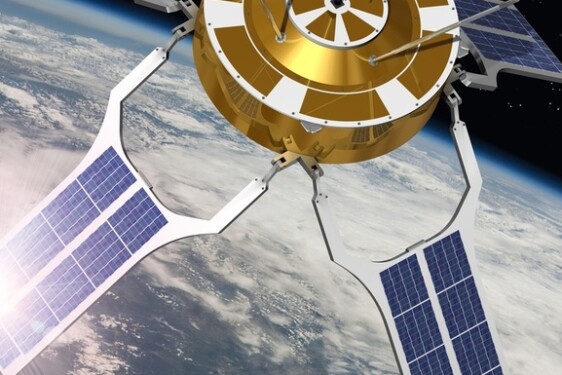
The ESA Earth Explorer Swarm mission comprises 3 satellites on 2 polar orbits at ~500/450 km altitudes, to investigate all sources of the Earth’s magnetic field. The mission being in very good health, mission extension is now considered by ESA up to at least end of 2028.
Each satellite carries a payload to measure the magnetic field and space plasma properties. Of particular interest for this thesis are the Absolute Scalar Magnetometers (ASM), developed by CEA-Léti and provided by CNES, under the scientific responsibility of IPGP. These ASM nominally provide 1 Hz scalar magnetic data for scientific investigations and calibration of the Vector Fluxgate Magnetometers (VFM), the mission’s primary magnetic instrument. Since 2019, however, the ASM on 2 of these satellites have been regularly operated in an experimental burst mode, acquiring one week of 250 Hz scalar data every month. These data have revealed many electromagnetic signals, both natural and of artificial origins [Emsley et al, 2025]. In particular, lightning-generated whistlers are routinely detected and now provided as an official product of the mission [Coïsson et al. 2025]. This unique dataset offers new opportunities to investigate the ionospheric environment below the satellites.
Our team is also leading the future ESA Scout NanoMagSat mission, which will deploy 3 nano-satellites on a polar orbit and on two 60° inclined orbits, to complement/take over the Swarm mission. With a 1st launch planned end of 2027 and full deployment in 2028, it will have the enhanced ability to continuously measure both the scalar and vector magnetic field at 2 kHz.
The overarching goal of this thesis is to take advantage of the existing Swarm 250 Hz scalar data and future NanoMagSat 2 kHz scalar/vector data, along with ground-based observations, to improve our still limited understanding of the electromagnetic coupling between the neutral atmosphere and the ionosphere in the Extremely Low Frequency (ELF) range.
The main signals of interest will be the lightning-generated whistlers produced by strong lightning strikes, when a fraction of the emitted energy penetrates the ionosphere and reaches satellite altitudes. This propagation depends on the magnetic field orientation and on the characteristics of the ionospheric plasma. Investigation of these signals can therefore provide important insight on the distribution of lightning in the neutral atmosphere, the conditions allowing the ELF signal to penetrate the ionosphere, and the state of the ionosphere along their propagation path up to the satellites.
We already showed that arrival-time of whistler frequencies can be used to measure a new ionospheric parameter, the Total square Root Electron Content (TREC) [Jenner et al., 2024]. This technique, based on ELF ray-tracing, is particularly suitable at mid and low-latitudes, where useful approximations can be made. Initial studies of specific classes of whistlers already showed how this TREC measure can be used for testing and improving empirical ionospheric models, such as the International Reference Ionosphere (IRI) model [Bilitza et al. 2022], and for assimilative models.
Many other classes of whistlers are yet to be investigated, such as highly dispersed ELF transequatorial whistlers, not yet modelled, due to our current propagation software being limited to ionospheric altitudes. Developing an efficient full 3D ionospheric and plasmaspheric ray-tracing technique for ELF propagation will be one of the major goals of this project. Further advances in the understanding of these signals could also be achieved by adapting full-wave models to ELF signals propagation. These developments will primarily be made for the purpose of exploiting the available Swarm Burst mode data, but additional developments are planned to next analyze the future NanoMagSat 2 kHz scalar and vector data (starting in 2028). Such vector data will further allow polarization of the whistlers to be analyzed, providing additional information on the ionospheric properties.
The candidate will join the IPGP geomagnetism team and benefit from the experience of this team with the Swarm and NanoMagSat missions. The candidate will exploit and improve sophisticated software and algorithms and is expected to successfully contribute to the exploitation of both missions.
Bilitza et al. (2022) The International Reference Ionosphere model: A review and description of an ionospheric benchmark, doi:10.1029/2022RG000792
Coïsson et al. (2025) Global occurrences of whistlers detected in the Extremely Low Frequencies during Absolute Scalar Magnetometer burst mode acquisition campaigns of the Swarm mission, doi:10.1051/swsc/2025048
Emsley et al. (2025) Swarm Absolute Scalar Magnetometer burst mode: observed ELF signals and their origins, doi:10.1051/swsc/2025028
Jenner et al. (2024) Total Root Electron Content: A New Metric for the Ionosphere Below Low Earth Orbiting Satellites, doi:10.1029/2024GL110559
=================
For more Information about the topics and the co-financial partner (found by the lab !); contact Directeur de thèse - gh@ipgp.fr
Then, prepare a resume, a recent transcript and a reference letter from your M2 supervisor/ engineering school director and you will be ready to apply online before March 13th, 2026 Midnight Paris time !
Profile
Laboratoire
MESSAGE from Phd Team
More details on CNES website : https://cnes.fr/fr/theses-post-doctorats