Mission
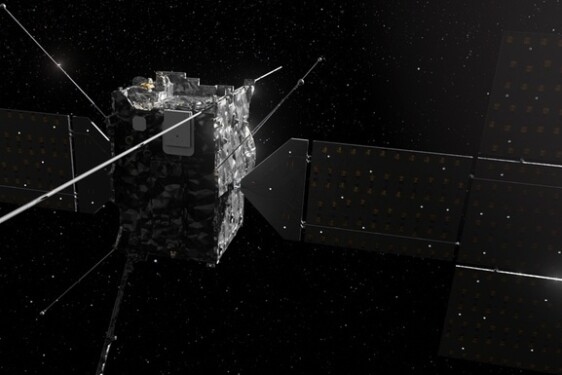
The ESA mission JUICE (Jupiter Icy Moons Explorer), launched in April 2023, targets Ganymede, the largest moon of the Solar system. This is the only known extraterrestrial body to possess both an internal liquid ocean, buried below a surface ice layer, and an intrinsic magnetic field produced by a dynamo operating in an iron core. The present internal structure and dynamo of Ganymede are the result of the long-term thermo-chemical and orbital history of this moon from a post-accretion undifferentiated icy core. The future characterization of Ganymede’s internal structure and magnetic field by JUICE (Van Hoolst et al., 2023) will thus provide a unique opportunity to relate present-day observations to the global history of Ganymede and the Jovian system.
Like for the Earth’s outer core, a key question relates to the different mechanisms that have driven Ganymede’s dynamo up to the present day. These depend strongly on the composition and thermal history of the core, and may produce distinct magnetic field morphologies. In the line of Christensen (2015), most models so far have considered an « iron snow » hypothesis, which assumes that core crystallisation proceeds from the top and the outermost core is chemically stratified, filtering the small scales of the magnetic field produced underneath. Yet, alternative ways exist to power the dynamo. In particular, thermodynamics of the Fe-S alloy predicts that, during core formation, the composition of the liquid metal added to the growing core varies with time and becomes increasingly depleted in sulfur. If the formation of the core is still ongoing at present, this could drive chemical convection from the top of the core and power a dynamo. Both mechanisms may produce distinct magnetic field morphologies and hence specific signatures in the existing Galileo and future observations of JUICE, for instance in the relative strength of the dipole compared to quadrupolar and higher order components of the magnetic field.
The objective of this thesis is to prepare for the interpretation of data from the JUICE mission and to provide a new view on Ganymede’s core and dynamo, by inscribing them into the more general framework of the thermal and orbital history of this moon.
This thesis will build on the combination of two state-of-the-art numerical tools. The first one is the 1-D code BOREAS developed by Mathis Pinceloup during his PhD started in 2023 at LPG, Nantes, under the supervision of Christophe Sotin and colleagues (first paper in preparation, see the recent EPSC abstract by Pinceloup et al.). This novel code models the multiphase evolution of undifferentiated icy cores during their thermal history. It self-consistently tracks the co-evolution of solid and liquid phases by solving coupled conservation equations for mass, momentum and energy to resolve porosity-driven melt compaction. Current developments aim at including tidal heating, which will allow to link the evolution of Ganymede to that of the Jovian system. The second tool is the PARODY-PIC code (Bouffard et al., 2017), developed under the supervision of Gaël Choblet at LPG and colleagues, which allows for the modelling of thermo-chemical convection sustaining dynamos in planetary cores. Both codes are currently unique in the planetary physics community. Their combination will allow to inscribe, for the first time, the present dynamo of Ganymede into the broader history of this moon and that of the Jovian system, based on the data from the JUICE mission.
The PhD will take place at the Laboratoire de Planétologie et Géosciences in Nantes. The advisors will be Benoit Langlais (co-I of the J-MAG instrument of JUICE) and Hagay Amit (expert on planetary dynamos modelling). The work will further benefit from collaboration with Gaël Choblet and Gabriel Tobie, who are involved as co-I of different instruments of JUICE. The PhD will first focus on implementing a numerical treatment for the Fe-S eutectic system into the BOREAS code by solving a transport equation for sulfur. Second, different scenarios for the formation of Ganymede’s core will be explored, depending on accretion mechanisms, initial composition, radiogenic heating and early tidal heating. This will allow to unravel the possible evolutions of the core and the nature of dynamo drivers throughout the history of Ganymede. Third, a series of dynamo models will be run with the PARODY-PIC code to relate these thermal histories and dynamo mechanisms to the morphology of the magnetic field. The outputs of these models (time evolution of the magnetic field expanded into spherical harmonics) will be compared to a re-examination of Galileo magnetic field measurements, and will eventually allow to make predictions for the future observations by JUICE.
=================
For more Information about the topics and the co-financial partner (found by the lab!); contact Directeur de thèse - benoit.langlais@univ-nantes.fr
Then, prepare a resume, a recent transcript and a reference letter from your M2 supervisor/ engineering school director and you will be ready to apply online before March 13th, 2026 Midnight Paris time!
Profile
Laboratoire
MESSAGE from Phd Team
More details on CNES website : https://cnes.fr/fr/theses-post-doctorats