Mission
Spatial structures are subjected to various vibration amplitudes during lift-off and in-orbit flight phases provided by different sources (e.g.: acoustic waves, aerodynamic loads, combustion engines, shock loads, internal systems). The dissipation of vibratory energy in such structures plays a crucial role and taking it into account during the design process can be beneficial in lighting the weight of structures.
Classical vibration mitigation device are typically made of elastomeric parts that are temperature-dependent and therefore less space-resilient than metallic technologies. Moreover, the hypothetic presence of atomic oxygen in low earth orbits might damage the integrity of the surface of the device. New technological solutions should be developed, meeting qualification specification and those constraints.
Vibration mitigation can be addressed by different means, either by filtering, dissipating energy, or transferring energy to a subsystem. Using the latter option coupled to the excellent dampening qualities of granular materials, a particle damper is a passive vibration control device consisting of granular materials embedded in a specific cavity, that dissipate energy by inter-particle friction that lowers a structure's vibration amplitude over a broad frequency range. Particle damper energy dissipation is an extremely complex and nonlinear physical phenomenon. Prior research has demonstrated that a particle damper's damping process is dependent on a variety of variables, including the number of particles, filling ratio, granular material, and particle size and shape. Nevertheless, particle dampers usually imply a significant added mass and could also exhibit detrimental shock phenomena to the overall structure.
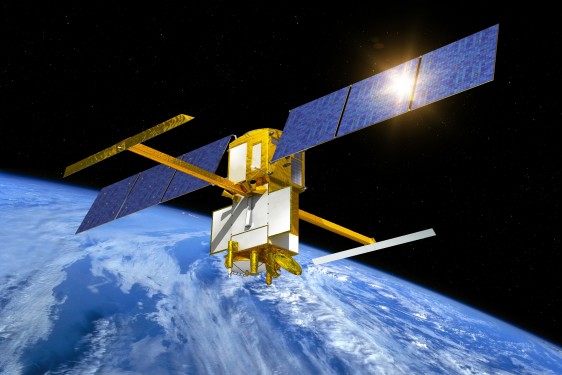
To tackle these challenges, this PhD proposal focus on a new physical concept of powder dampers. It consists of a small container filled with powder (metallic particles of small granulometry compatible with additive metallic manufacturing process), that overcome the limitations of classical particle dampers. This study will especially focus on micro-vibrations due to satellite internal excitation sources such as inertia wheels, gyroscopes or any actuators.
The present thesis proposal concerns the development of powder dampers dynamic model and a characterization procedure based on experimental vibration tests. Moreover, understanding the physical behavior of powder dampers depending on their characteristics is a major avenue since it will allow a better modeling of dissipation mechanisms. The design of an optimal device will be addressed for maximizing the dissipation mechanism of the damper. The work will be based on theoretical, numerical (Discrete Element Method) and experimental complementary approaches, initially on academic cases to understand the phenomena involved, and then on spatial applications.
=================
For more Information about the topics and the co-financial partner (found by the lab!); contact Directeur de thèse - guilhem.michon@isae-supaero.fr
Then, prepare a resume, a recent transcript and a reference letter from your M2 supervisor/ engineering school director and you will be ready to apply online before March 13th, 2026 Midnight Paris time!
Profile
Laboratoire
Message from PhD team
CNES will inform about the status of your application in mid-June. More details on CNES website : https://cnes.fr/en/web/CNES-en/10685-st-doctoral-grants.php