Mission
A fundamental concern of the science and policy agenda is the impact of climate change on world’s ecosystems and the cascading consequences on human societies particularly in the poorest countries which are hotspots of food insecurity like in Eastern Africa. Here we make the hypothesis that coastal and rural villages are more likely to have mitigated or even avoided poverty and outmigration during the last three decades of land desertification when developing a sustainable blue economy providing alternative resources and livelihoods.
To test this core hypothesis, we will rely on a long-term causal inference framework combining satellite imagery, artificial intelligence algorithms, and matching statistical methods. We will focus on Madagascar where most people outside large cities rely on their immediate natural environment for subsistence, health and development. More precisely, our project has the ambition to quantitatively assess whether (i) maintaining productive and healthy coral reefs through the establishment of marine protected areas, (ii) investing in mariculture, or (iii) developing eco-tourism are potential transformation pathways to improve wealth assets and prevent outmigration from rural villages along the coast of Madagascar.
For that, four main tasks will be achieved within 36 months:
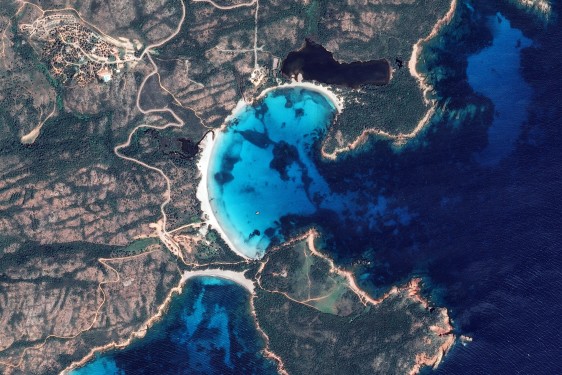
1. Delineating and characterizing (size, land use, presence of blue economy) all rural socio-ecological systems (RSES) on the coasts of Madagascar using high resolution satellite imagery (Pleiades).
2. Using available artificial intelligence algorithms based on convolutional neural networks to accurately predict the level of human poverty and density across space and time on coastal villages of Madagascar using satellite images (Sentinel, Pleiades, Landsat).
3. Testing the causal link between the establishment of a sustainable blue economy since the 2000’s and the level of poverty and outmigration using a before-and-after protocol and a statistical matching method between control (no blue economy established) and treated (blue economy established) RSES.
The main conceptual breakthrough of the PhD is the holistic view of coastal socio-ecosystems at the interface between land and sea integrating human geography and demography, climate change impacts, ecosystem health, inter-sectorial socioeconomic outputs, and sustainable development. Linking blue economy interventions with the long-term dynamics (20 years) of rural poverty and outmigration remains an uncharted territory in international research. The extent to which coastal communities in Madagascar can better adapt to the aftermath of climate change impacts on their land by switching, expanding, or diversifying their activities towards the sea is totally unknown at large spatiotemporal scale.
The second main breakthrough is the collaborative approach of big data and artificial intelligence to assess causality at large spatial and temporal scale between three activities of the blue economy and two major socioeconomic outcomes: human poverty and outmigration in rural villages. In such isolated areas of Africa, local socioeconomic data remain sparse and heterogenous hindering any attempt to link policy or management interventions causally and quantitatively to key livelihood, demographic or well-being outcomes. Here we propose to rigorously integrate social and environmental science in a quantitative framework taking advantage of the coupling between big data and artificial intelligence. More precisely, we plan to rely on pre-trained transformers or convolutional neural networks for temporal and multi-spectral satellite imagery in order to accurately predict the level of human poverty and net migration in all coastal and rural villages across eastern Africa since almost 20 years. Then we will combine the advantages of spatial matching methods and response curve models to better explain and understand poverty and outmigration alleviation processes.
This interdisciplinary project lies at the interface between human, socioeconomic and environmental sciences. It will reinforce the collaboration between the CNES and two major academic laboratories at the forefront of international efforts to better understand and promote a sustainable future in the developping world.
Overall, the project is medium-risk medium-gain in terms of methodology since we are using already developed statistical, artificial intelligence and survey tools that we aim to improve or adapt to our case study, but can be considered as high-risk high-gain regarding scientific and societal impacts since the causal links between blue economy interventions and local socioeconomic outcomes remain largely hypothesized, controverted, misunderstood and unquantified at large spatiotemporal scale while they may unlock important development and adaptation potential.
The PhD student will be supported by internal fundings for her/his functioning including visits to CNES and field trips to Madagascar.
=================
For more Information about the topics and the co-financial partner (found by the lab!); contact Directeur de thèse -david.mouillot@umontpellier.fr
Then, prepare a resume, a recent transcript and a reference letter from your M2 supervisor/ engineering school director and you will be ready to apply online before March 13th, 2026 Midnight Paris time!