
Mission
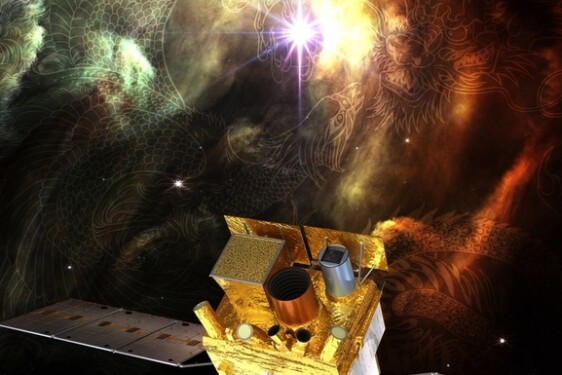
The SVOM multi-wavelength observatory entered its scientific exploitation phase early 2025, a few months after the successful launch of its satellite on June 22, 2024. The mission is dedicated to the study of Gamma-Ray Bursts (GRBs), which are highly energetic explosive phenomena that can be detected from the very distant Universe. GRBs are associated with cataclysmic events (explosion of a massive star or coalescence of compact objects) leading to newborn stellar-mass black holes with an ultra-relativistic jet. The GRB so-called prompt phase is a brief (0.01 s to minutes), intense and erratic emission of hard X-rays and gamma rays. It is followed by an afterglow phase resulting from the jet interaction with the circum-burst medium.
The thesis will mainly exploit GRB observations with the French ECLAIRs coded-aperture telescope (4-120 keV), which in charge of GRB detection and localization. The PhD student will also make use of GRB data from the Chinese GRM (Gamma-Ray Monitor, 0.05-5 MeV), which extends the spectral coverage to much higher energies. Together, the two instruments have detected about 200 GRBs so far.
(1) GRB prompt emission analysis and physical interpretation in the synchrotron scenario
The physical mechanisms which are responsible for the GRB bright prompt emission are still debated. Whereas a non-thermal emission is expected from electrons accelerated by shocks in the jet or by magnetic reconnection, a quasi-thermal emission can be produced near the photosphere in very weakly magnetized jets ("fireball" scenario). To investigate this question, the PhD student will analyze ECLAIRs (and GRM) observations of the GRB prompt phase using different synchrotron models developed at LUPM and at IAP (Institut d'Astrophysique de Paris, the LUPM main partner in SVOM). He/she will develop a complete analysis chain to test the hypothesis of an internal-shock synchrotron origin of the prompt emission: data selection, data preparation, light curve segmentation, time-resolved spectral fits using empirical and physical models, post-processing scripts. In particular, the identification of emission pulses that mark different episodes of electron acceleration in the jet, will help compare properly the observed spectra with the theoretical expectations. This study will make use of the largest sample possible, focusing on the most fluent GRBs in order to reach the spectral accuracy that is required to distinguish between models. The software development will also benefit to other analyses of SVOM GRB populations, and to catalog publications which will start during the thesis.
The PhD student will also search for quasi-thermal components in GRB spectra, of primary importance. This photospheric emission is directly related to the initial energy reservoir and to the jet magnetization. The ECLAIRs low-energy detection threshold of 4 keV is particularly suited to study this soft emission, which was/is difficult to conduct using past/existing gamma-ray space instruments with higher detection thresholds (Fermi, Swift).
(2) Scientific operations
Several times each month, the PhD student will be on duty as Instrument Scientist (IS) within the ECLAIRs Instrument Center. As expert in the ECLAIRs (and GRM) analysis software, the IS validates the official high-level scientific products (about 50 per GRB): light curves, emission durations, hardness ratios, broadband spectra, flux, fluences, spectral lags, luminosity and energetics (if the distance is known). The IS broadcasts also his/her preliminary analysis of each GRB to the world-wide community via circulars of the NASA General Coordinates Network (GCN).
Moreover, the PhD student will take Burst Advocate (BA) shifts ~20 days per year. The SVOM BA plays a crucial operational role: for each onboard alert, he/she supervises its validation as an astrophysical source, the generation of the scientific products from all SVOM instruments (in coordination with the IS's), the writing of the first high-energy GCN circular, and the ground follow-up observations with SVOM partners.
The IS and BA activities will allow the PhD student to play a leading role in the publication of individual GRBs of interest occuring during his/her shifts.
Local environment: The LUPM group is expert in GRB high-energy prompt emission, with a long-standing and strong experience in Fermi and Swift. In SVOM, the group is co-responsible with IAP for the ECLAIRs (and ECLAIRs+GRM) GRB analysis pipelines on ground. M.-G. Bernardini is co-convenor of the SVOM GRB Science Working Group. F. Piron is co-convenor of the ECLAIRs / GRM interface group (including Chinese partners at IHEP, Beijing), and co-convenor of the ECLAIRs Analysis Group. He was recently tasked with coordinating the study of jet synchrotron emission scenarios through combined ECLAIRs+GRM analysis. In the near future, the LUPM group will also be strongly involved in the preparation of ECLAIRs and ECLAIRs+GRM catalogs of GRBs.
=================
For more Information about the topics and the co-financial partner (found by the lab!); contact Directeur de thèse - piron@in2p3.fr
Then, prepare a resume, a recent transcript and a reference letter from your M2 supervisor/ engineering school director and you will be ready to apply online before March 13th, 2026 Midnight Paris time!
Profile
Infos pratiques
Mot du recruteur
More details on CNES website : https://cnes.fr/fr/theses-post-doctorats