Mission
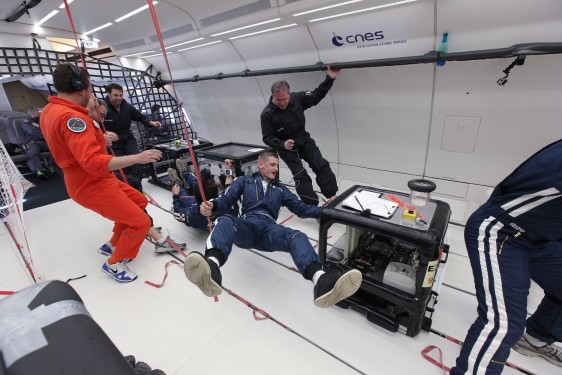
This PhD project builds upon the remarkable progress achieved in the PHOeBUS project (Flight ObsErvation of Butterflies Under Space-like gravity), which investigates butterfly flight adaptation under micro- and hyper-gravity during parabolic flights. Initiated in 2021 and supported by CNES, we reached a major milestone in 2025 with two highly successful parabolic flight campaigns (April and October), enabling for the first-time high-resolution 3D reconstructions of butterfly trajectories and wing-beating dynamics under varying gravity levels.
The proposed PhD will extend this work beyond kinematic characterization to encompass the aerodynamic flow field generated by flapping flight in altered gravity. Its goal is to achieve a comprehensive understanding of lift generation and control in natural flyers and to identify the coupling between wing kinematics, wake structures, and aerodynamic forces.
Beyond its biological relevance, this research is expected to advance our understanding of unsteady aerodynamics and inform the design of micro aerial vehicles operating in rarefied or reduced-gravity environments.
Context and Objectives
We have established an innovative imaging approach using neuromorphic cameras that record events asynchronously at microsecond precision, offering temporal resolution above 10kHz with low data rates. This breakthrough enables unprecedented detail in the study of insect wing motion. In the 2025 campaigns, nine neuromorphic cameras mounted in a dedicated flight enclosure aboard the A310 AirZero-G aircraft captured hundreds of flight sequences of Greta oto and Heliconius charitonia butterflies. Preliminary analyses revealed clear variations in wing-beat frequency and amplitude with gravity, and intriguing evidence of adaptation over successive parabolas.
The next step, and the core of this PhD, is to move from motion reconstruction to flow characterization. The project will focus on:
1. Extending the experimental setup to allow simultaneous tracking of the surrounding airflow using PIV or particle tracking techniques safe for butterflies.
2. Quantifying aerodynamic forces by correlating measured wing kinematics with reconstructed velocity and pressure fields.
3. Developing and validating numerical simulations of flapping-wing flow using high-fidelity solvers constrained by experimental data.
4. Investigating adaptation mechanisms by analyzing how variations in wing-beat frequency, amplitude, and deformation affect aerodynamic efficiency under changing gravity.
Methodology
The PhD will combine advanced experiments and simulations. Experimentally, the candidate will upgrade the current butterfly flight cell with controlled seeding and illumination systems for flow imaging. Two diagnostic approaches are considered: (i) classical helium soap-bubble velocimetry, and (ii) a novel water-droplet method minimizing disturbance while maintaining humidity. Both will be validated in ground tests before flight implementation. The PhD project will be led in collaboration with Ariane Gayout, currently at Groningen University.
In parallel, the candidate will collaborate with Thomas Engels (CNRS, Institut des Sciences du Mouvement, Marseille) to perform numerical simulations of flapping flight using experimentally measured wing motions as inputs. These simulations will resolve the unsteady vortex structures responsible for lift and thrust. A second collaboration with Shaifali Parashar (CNRS, LIRIS, Lyon) and Vincent Debat (MNHN, Paris) will focus on 3D reconstruction of dynamically deforming wings from neuromorphic data using machine-learning techniques.
Combining experimental and numerical approaches will yield a full mapping between insect motion, resulting flow, and aerodynamic forces. This dataset will be unique in the field of biological flight and may open new perspectives in bio-inspired aerial robotics.
Program continuity
This PhD continues François Schweitzer’s ongoing doctoral work (2023–2026), co-funded by CNES and ENS de Lyon, focused on butterfly flight kinematics under variable gravity. His thesis has provided the experimental foundations for this proposal. Launching a new doctoral project immediately after its completion would be an exceptional opportunity to sustain the current scientific momentum and fully exploit the infrastructure, expertise, and enthusiasm generated by PHOeBUS.
The requested PhD funding will thus open a new ambitious phase of the project, aiming at a full aerodynamic characterization of butterfly flight. By uniting advanced imaging, numerical modeling, and biological insight, this thesis will bridge disciplines and deepen our understanding of how natural flyers adapt their strategies to radically different physical environments. Continuing the adventure of through this PhD would be a unique scientific and human opportunity, ensuring the long-term success of one of the most original research efforts in biological fluid dynamics today.
=================
For more Information about the topics and the co-financial partner (found by the lab!); contact Directeur de thèse - nicolas.plihon@ens-lyon.fr
Then, prepare a resume, a recent transcript and a reference letter from your M2 supervisor/ engineering school director and you will be ready to apply online before March 13th, 2026 Midnight Paris time!
Profile
Infos pratiques
Mot du recruteur
More details on CNES website : https://cnes.fr/fr/theses-post-doctorats