
Mission
Technological context and scientific questions
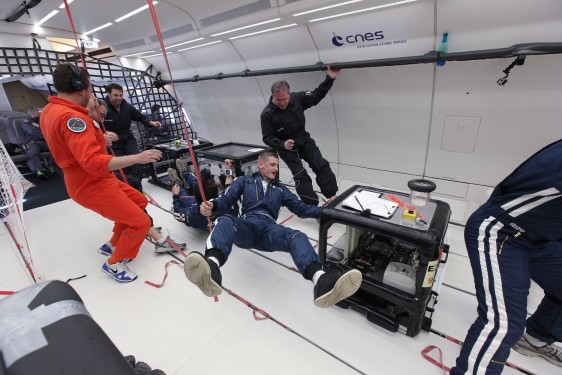
During depressurization for propellant preconditioning (and cooling) prior to engine ignition or propellant transfer (in the context of space depots), bubbles can form and grow due to cavitation [1]. This is a problem due to vapour accumulation under microgravity conditions and the impact on wall heat transfer. More generally, cavitation, under conditions where phase change predominates, is important for many applications (including nuclear power plants) and raises many questions that are not understood at the small scale. This justifies the development of the SCREAMH2 microgravity pool cavitation experiment (currently in phase A/B development under an ESA contract), in which ISAE-Supaero is participating as part of the scientific team.
There are several scientific open questions regarding pool cavitation. It is unclear how the contact line phenomena (nano-region, wall roughness, cavity shape…), the level and dynamics of depressurization, and the nature of the fluid (pure or in the presence of non-condensable gas) impact the growth of these bubbles and the associated wall heat flux.
This thesis project aims to answer these questions by developing numerical models capable of accurately simulating pool cavitation, in parallel with the development of the SCREAMH2 experiment. The results will serve, on the one hand, as support for the experiment and, on the other hand, for its extension, particularly to configurations with multiple bubbles and in the presence of non-condensable gases.
Background
The present project is a continuation of the team's recent work on the development of a solver for the direct numerical simulation of two-phase flows with phase change [2,3,4]. The originality of the solver, based on a semi-implicit compressible projection method, lies in its thermodynamic consistency, which allows it to describe liquid, vapor, and saturation conditions at the interface for a generic fluid.
The solver has recently been extended to phase change in the presence of a contact line (solid, vapor, liquid) and validated for the simulation of nucleate boiling and pool cavitation. It has thus enabled parametric studies and models developments for bubble cavitation in microgravity at the wall. The models will be extended in this project.
Project development
This project aims to further develop the numerical solver and use it to answer the scientific questions raised.
1. Numerical development of the immersed boundary method [5] to include conjugate heat transfer and contact lines. After validation on basic test cases, configurations with complex geometries will need to be addressed. Initially, the simulation of CH4 pool cavitation used for validation in [4] will be reconsidered with the complex geometry (cylindric support and cavity for the bubble).
2. Incondensable gas. The solver will be extended to account for the presence of multi-species vapor and incondensable gas adsorption in the liquid while ensuring thermodynamic consistency at the interface. A surface tension model dependent on local composition will be developed, and the jump conditions will be adapted to take thermo-capillary effects into account. The model will need to be validated for simulation in the presence of Marangoni currents (using existing experimental data).
3. Pool cavitation in micro-gravity. Several objectives will be pursued. The first will be to support the SCREAM H2 project with detailed numerical simulations. The second will be to extend the study of pool cavitation to many fluids, considering non-condensable gases and various geometric configurations. In particular, the phase change models developed in [4] will be extended and used to simulate multi-bubble configurations, the interaction between bubbles and their impact on wall heat transfer in microgravity.
Impact
While this project focuses on pool cavitation in microgravity, it is important to note that the developments envisaged are also intended to simulate and study other phenomena involving phase change in compressible flows in the presence of contact lines. These include 1) sloshing in tanks and 2) hydrodynamic cavitation with the development of cavitation pockets. It is planned to study such configurations towards the end of the thesis project, depending on how the project progresses.
References
[1] A. Simonini, M. Dreyer, A. Urbano, F. Sanfedino, T. Himeno, P. Behruzi, M. Avila, J. Pinho, L. Peveroni and J.-B. Gouriet, NPJ microgravity Nature,10:34(2024)
[2]A. Urbano, M. Bibalm S. Tanguy, J. Comp. Phys., 456:111034 (2022)
[3] M. Bibal, M. Deferrez, S. Tanguy and A. Urbano, J. Comp. Phys., 500:112750 (2024)
[4] M. Deferrez, S. Tanguy, C. Colin and A. Urbano, Int. J of Heat and Mass Trans. 254, p127612 (2026)
[5] S. Coseru, S. Tanguy, P. Freton, J.-J. Gonzalez, A. Urbano, M. Bibal, G. Bourdon, J. of Comput Phys. 524, p.113714 (2025).
=================
For more Information about the topics and the co-financial partner (found by the lab!); contact Directeur de thèse - annafederica.urbano@isae-supaero.fr
Then, prepare a resume, a recent transcript and a reference letter from your M2 supervisor/ engineering school director and you will be ready to apply online before March 13th, 2026 Midnight Paris time!
Profil
Laboratoire
Message from PhD team
More details on CNES website : https://cnes.fr/fr/theses-post-doctorats