
Mission
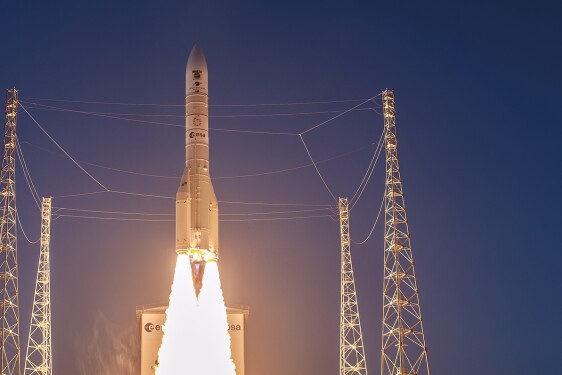
In the current context of intense international competition in the launch vehicle sector, France must remain competitive, particularly in the United States. One of the challenges for remaining competitive is to develop a reusable launch vehicle in the coming years. A launch vehicle is generally composed of several stages, which ideally could be reusable. To develop these reuse techniques, CNES and ArianeGroup, along with other European (DLR) and international (JAXA) stakeholders, are developing several intermediate experimental vehicles such as CALLISTO.
To enable the reuse of a rocket stage, numerous scientific and technical challenges must be overcome. Among these challenges, controlling the descent trajectory is essential. Generally, the nominal trajectory is disrupted by forces and moments in the launcher's three axes. The origin of these forces is primarily due to the highly unsteady dynamics of the flow around the launcher, itself fueled by the nozzle jet, which will be significantly impacted by the toss-back descent mode envisaged for the vast majority of reusable launchers. An analysis of this dynamic through experimental campaigns is currently being conducted by the Pprime Institute (V. Jaunet) and has provided information on the dynamics and its spatial structure. For its part, the DynFluid laboratory is currently performing URANS/RANS simulations to access the statistical characteristics of the flow, which can reproduce the low-frequency dynamics observed experimentally. Indeed, for a URANS method to capture unsteady conditions, the spatio-temporal scales must be sufficiently decoupled from the scales of the modeled turbulence. The DynFluid laboratory has also developed linear stability methods in the dNami tool, allowing the extraction of the modes responsible for this low-frequency unsteady dynamics from linearized URANS simulations, in shorter times compared to LES-type simulations, for example.
As part of the ATAC group (Aerothermodynamics of Nozzles and Afterbody), the objective of this thesis proposal is to address the case of the descent of a first stage of a launcher using this same type of approach, with the aim of predicting the observed unsteadiness, their spatio-temporal characteristics, and determining the thresholds for the occurrence of these unsteady phenomena at low frequencies. The DynFluid laboratory and the Pprime Institute propose to experimentally and numerically study the dynamics of cold counterflow supersonic jets for different flow regimes ranging from subsonic to transonic.
The underlying objective is to advance fast computational tools validated using new experimental data and our understanding of the physical phenomena involved. This would be used to design nozzles robust to counterflow conditions, by identifying their critical modes that could impact the base equipment or launcher control. In the longer term, the dNami calculation tool, thanks to automatic differentiation methods (code generation), will be able to account for hot gas and combustion effects, bringing the use of this methodology closer to future industrial applications.
The proposed thesis will proceed generally as presented below. It should be noted that some of the identified tasks (Types 1 to 3) may be carried out in parallel:
1) Establishment of an experimental design for an experimental parametric study: jet Mach, infinite Mach, stage angle of incidence, generator/atmosphere pressure ratio. The influence of nozzle type (TIC/TOC/TOP) on jet dynamics can also be studied. Identification of cases of interest by quantifying flow dynamics for the subsequent theoretical analysis.
2) Obtaining mean field and instantaneous visualizations for the cases of interest to validate the numerical results.
3) Performing URANS numerical simulations with a k − ω SST turbulence model with compressibility correction. Calculation of the time-averaged field, frequency calculation (PSD spectrum), and dynamics analysis (SPOD).
4) Calculation of the fixed-point solution: the RANS solution using a Krylov-Newton method. Comparison of RANS and averaged URANS.
5) Calculation of linear stability around the RANS solution, calculation of the eigenvalue spectrum and associated eigenfunctions.
6) Physical analysis of the results. Comparison of Pprime experiments, URANS simulations, and linear stability analyses.
=================
For more Information about the topics and the co-financial partner (found by the lab!); contact Directeur de thèse -Jean-Christophe.Robinet@ensam.eu
Then, prepare a resume, a recent transcript and a reference letter from your M2 supervisor/ engineering school director and you will be ready to apply online before March 13th, 2026 Midnight Paris time!
Profil
Laboratoire
MESSAGE from Phd Team
More details on CNES website : https://cnes.fr/fr/theses-post-doctorats