
Mission
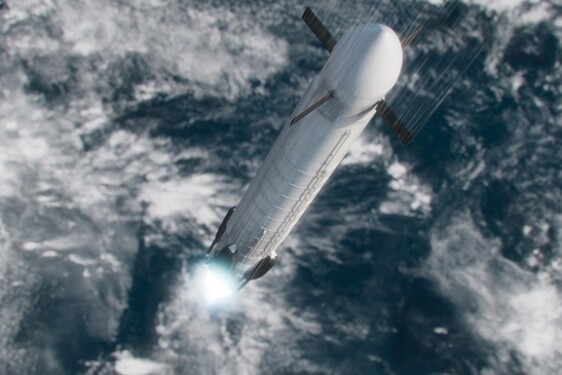
Reusable launch vehicles (RLVs) like SpaceX Starship, Blue Origin New Glenn, and ArianeGroup Themis or Callisto are revolutionizing space access—but their return phase remains a critical challenge. Unsteady pressure fluctuations, aerodynamic side loads and jet-flow interactions threaten stability and control, thus challenging reusability. Experimental data in this regime is scarce, limiting CFD validation and design optimization. A better knowledge of the flow dynamics through experiments is crucially required [1].
This theoretical and experimental PhD project focuses on wind tunnel testing to investigate flow dynamics around reusable launch vehicles during their critical return phase and stability analysis of the resulting flow. The primary goal is to characterize the flow environment during reentry, in particular the fluctuating aerodynamic loads associated with the transonic and supersonic, which are damaging for the launcher. The research precisely targets the dynamics of bluff body in a counter flow and counter jet, using models of simple canonical geometries, through experimental and stability investigations [2]. The improved knowledge of the flow dynamics will lead to the proposal and test of control strategies to mitigate these flow fluctuations.
A key innovation of this work lay in the experimental approach with wind tunnel testing and advanced flow diagnostics. The project will employ an advanced measurement technique, unsteady Pressure-Sensitive Paint (PSP) for high-resolution pressure fluctuation measurements, alongside flow visualization tools such as schlieren or BOS [3], and pressure sensors. In particular, PSP will allow an efficient diagnostic to characterize the unsteadiness in time and space [4]. Furthermore, the stability analysis step, supported by these experimental data, will allow a broader analysis in parameter space and open up ways to evaluate the sensitivities of the unsteadiness to the geometry of the launcher body. This research will shed a new light on unsteady flow phenomena in launcher return flights and hopefully will provide solution guidelines to minimize side loads in these regimes.
This project is a unique opportunity to directly impact the design of the next-generation of reusable rockets. If you're passionate about space exploration, cutting-edge experimentation, and innovation, this is your chance to shape the future of space travel!
References:
[1] Weiss P.-E. and Deck S. Towards a numerical multi-fidelity strategy for unsteady aerodynamics studies of reusable launch vehicles: Application to Ariane Next, 9th European Conference for Aeronautics and Space Sciences (EUCASS), Flight Physics, Launcher Aerodynamics, Lille, France, 27 June - 1 July 2022.
[2] Morilhat, S. (2023, March). Experimental analysis of a retro-propulsion jet of a launcher's first stage at Mach 6. In AERO 2023.
[3] Nicolas, Francois, et al. "Experimental study of a counter-flow jet in ONERA’s S1MA wind tunnel by 3D background oriented schlieren." ISFV 18. 2018.
[4] Merienne, Marie-Claire & Coponet, D. & Luyssen, J.-M. (2012). Transient Pressure-Sensitive-Paint Investigation in a Nozzle. AIAA Journal. 50. 1453-1461.
=================
For more Information about the topics and the co-financial partner (found by the lab!); contact Directeur de thèse - vincent.brion@onera.fr
Then, prepare a resume, a recent transcript and a reference letter from your M2 supervisor/ engineering school director and you will be ready to apply online before March 13th, 2026 Midnight Paris time!
Profil
Infos pratiques
Mot du recruteur
More details on CNES website : https://cnes.fr/fr/theses-post-doctorats